How to Buy Property in Dubai with Cryptocurrency: A 2026 Practical Guide
Buying property in Dubai with crypto is fully workable in 2026. Route your funds through a VARA-licensed OTC desk to settle at the DLD in AED. This complete guide walks international investors through the exact step-by-step process, fees, and home-country tax rules.
For the broader context of accepted payment instruments, see our pillar guide on how to pay for property in Dubai , and for the traditional bank-issued alternative, see our sibling guide on paying with a Manager's Cheque in Dubai.
Is It Legal to Buy Dubai Property with Cryptocurrency?
Yes. Cryptocurrency is not legal tender in the UAE (only the AED is), but virtual assets are a fully regulated asset class in the Emirate of Dubai under the Virtual Assets Regulatory Authority (VARA), established by Dubai Law No. 4 of 2022. VARA licenses Virtual Asset Service Providers (VASPs) operating in or from Dubai (excluding DIFC, which falls under the DFSA). Crypto can therefore be lawfully exchanged for AED through a licensed VASP and the AED proceeds used to settle the property purchase at the DLD.
Key institutional pieces of the puzzle:
Dubai Land Department (DLD) records the title deed and registers the transaction in AED.
UAE Central Bank (CBUAE) issued the Payment Token Services Regulation in 2024, governing AED-referenced stablecoins.
DIFC (DFSA) and ADGM (FSRA) have their own crypto-token regimes that overlap at the edges.
In October 2024, DLD and VARA signed a Memorandum of Understanding to integrate virtual-asset infrastructure into the real-estate registry. In May 2025, DLD launched a real-estate tokenization pilot inside the government's Real Estate Sandbox, with fractional tokenized title interests issued through a licensed platform. As part of DLD's Real Estate Tokenisation Project strategy announced by DLD Director-General Marwan Ahmed bin Ghalita, tokenized real estate is targeted to reach approximately AED 60 billion (around 16% of Dubai's property transactions) by 2033.
paying for Dubai property with crypto is legal, but it is a crypto-to-AED-to-title-deed flow, not a peer-to-peer wallet transfer with crypto on the deed.
Who Is This Best For?
International investors holding significant BTC, ETH, or stablecoin balances who want to diversify into hard assets.
Buyers from jurisdictions with capital controls or banking frictions (some buyers from Iran, Russia, Turkey, Pakistan, Nigeria, Argentina, and parts of Asia find crypto rails faster than wires).
Expats already resident in the UAE wanting to deploy crypto holdings without first parking them in a UAE bank account.
Crypto-native founders or traders who simply prefer to transact in digital assets.
It is generally not the best route for buyers who already hold liquid AED in a UAE bank, or for buyers who want a mortgage funding most of the price (banks still need fiat for the loan portion, and underwriters look closely at crypto-sourced down payments).
Step-by-Step: How to Buy Dubai Property with Crypto
This is the practical core of the guide. The exact sequence depends on whether you buy off-plan from a developer or ready / secondary from an individual seller, but the skeleton is the same.
Step 1: Shortlist the Property and Confirm Crypto Acceptance
Not every developer or seller accepts crypto, and those that do usually have an internal SOP (preferred coins, preferred VASP, escrow arrangements, conversion timing). Confirm in writing before you sign anything:
• Which coins are accepted (BTC, ETH, USDT, USDC are the standard set).
• Whether the price is fixed in AED with crypto as a settlement method, or fixed in crypto.
• Who bears the exchange-rate slippage between agreement and settlement.
• Which VARA-licensed exchange or OTC desk will be used.
If you are not sure which developers or sellers currently accept crypto, this is exactly where most buyers get stuck. Contact us for the current shortlist of Dubai developers and projects accepting cryptocurrency, and for an introduction to the right VASP and conveyancer for your deal.Step 2: Agree on Price Denomination and FX Mechanics
There are two common structures:
1. AED-priced contract, crypto-settled. The SPA states a dirham price; the crypto amount is calculated on the day of settlement using a reference rate (often the VASP's mid-market rate at a defined time). This protects both sides from intra-deal crypto volatility because the AED number on the title deed is fixed.
2. Crypto-fixed price. Less common, used mainly for short-window off-plan deposits in stablecoins. Volatility risk falls on whichever party holds the coin between signing and settlement.
For most retail buyers, AED-priced contracts settled in stablecoins (USDT or USDC) are the safest combination.Step 3: KYC, AML, and Source-of-Funds Documentation
This is the step buyers underestimate. The VASP, the developer, the conveyancer, and (in some cases) the DLD trustee office will each run their own checks. The UAE is a FATF member; per the FATF Public Statement dated 23 February 2024, but compliance is rigorous. Expect to provide:
• Passport, Emirates ID (if resident), proof of address.
• Source-of-funds evidence for the crypto: exchange statements, mining records, employment income, prior asset sales, ICO/early-purchase evidence.
• Source-of-wealth narrative for larger transactions.
• Wallet ownership proof (signed message, screen-share, or Travel Rule data exchange).
• If the funds are from a corporate wallet: company UBO documentation, board resolution, audited financials.
Clean provenance matters not just for closing this deal but for your future ability to resell, mortgage, or remit proceeds out of the UAE.- Step 4: Choose the Cryptocurrencies You Will Actually Send
In practice, four assets dominate Dubai property settlement:
• USDT (Tether) and USDC (Circle) are the workhorses because they remove price volatility during the closing window. Most OTC desks quote tighter spreads on stablecoins than on BTC or ETH.
• Bitcoin (BTC) is widely accepted but introduces volatility risk and on-chain confirmation time (typically 10 to 60 minutes for sufficient confirmations).
• Ether (ETH) is accepted by most desks; gas fees are usually trivial relative to the deal size.
• Some desks quote BNB, XRP, LTC, or SOL on request, but expect wider spreads.
If you are holding a volatile coin, many buyers convert to a stablecoin before signing the SPA so that the AED equivalent at signing matches the AED equivalent at settlement. Step 5: Convert Through a VARA-Licensed Exchange or OTC Desk
This is the regulated chokepoint. The VASP performs the Travel Rule data exchange, the KYC, the AML screening, and the actual crypto-to-AED conversion. Named VARA-licensed Virtual Asset Service Providers operating in Dubai include Binance (licensed as Binance FZE), with additional holders listed on the VARA Licences Register at vara.ae. The desk will typically:
1. Onboard you (KYC, source-of-funds).
2. Receive your crypto into a segregated address.
3. Execute the conversion at an agreed rate (limit or market).
4. Wire AED to the seller's, developer's, or escrow account.
5. Issue a settlement confirmation acceptable to the DLD trustee office.
For larger deals (north of roughly AED 5 million in crypto), an OTC desk almost always gives better execution than a screen-traded exchange.Step 6: Sign the SPA with Clear Crypto Terms
The Sales and Purchase Agreement should explicitly cover:
• AED price and any crypto reference rate methodology.
• The licensed VASP that will execute the conversion.
• Wallet addresses and whitelisting.
• Timing of conversion (same-day, T+1).
• Allocation of conversion fees and network fees.
• Refund mechanics if the deal collapses post-transfer.
• Force-majeure language covering exchange outages or stablecoin de-pegs.
A conveyancer experienced in crypto-settled deals is essential; a standard DLD SPA template will not contain any of this.Step 7: Execute the Transfer
Two routes are common:
• Crypto-to-AED-then-pay (most common and safest): You send crypto to the VASP, the VASP converts and wires AED to the developer or to a DLD-recognized escrow/trustee. The deed is registered against the AED transfer.
• Direct crypto-to-developer wallet: Some developers have their own VARA-licensed corporate setup and can receive crypto directly, then convert internally. From the buyer's side, the visible flow is still crypto, but the developer's books and the DLD record show AED.
Either way, the DLD title deed is denominated in AED.Step 8: DLD Registration, Fees, and Title Deed
The standard Dubai property fees apply regardless of payment method:
• DLD transfer fee: 4% of the property value plus a small admin fee.
• Title deed issuance fee: around AED 580.
• Trustee office / registration fee: approximately AED 4,000 for properties above AED 500,000 (plus 5% VAT), AED 2,000 below.
• Agency commission: typically 2% plus 5% VAT.
• Oqood fee (off-plan): 4% of purchase price, paid into the Oqood register.
• NOC fee (resale): developer-specific, usually AED 500 to AED 5,000.
DLD fees are paid in AED. If you are converting only the property price into AED, remember to convert the fees too. Most buyers convert price plus fees plus a small buffer in a single OTC ticket.Step 9: Handover
• Ready / secondary: Title deed is issued the same day as transfer at the trustee office; keys handed over.
• Off-plan: Oqood is registered; the title deed itself is issued at project completion. Subsequent installments can also be paid in crypto, ideally on the same SOP and through the same VASP for compliance continuity.
End-to-end, a ready-property crypto-settled deal can close in two to four weeks, similar to a cash deal. Off-plan deposits can move in days.
Need help executing any of these steps?
Reach out for an up-to-date list of developers accepting cryptocurrency, an introduction to a VARA-licensed OTC desk, and a conveyancer who has actually closed crypto-settled deals. Avoiding the wrong VASP or the wrong SPA template is the single biggest saving you can make on a crypto property purchase in Dubai.
Fees and Costs: Crypto vs. Traditional
| Cost Item | Traditional (Manager's Cheque / Wire) | Crypto-Settled |
|---|---|---|
| DLD 4% transfer fee | Yes | Yes |
| Agency commission ~2% | Yes | Yes |
| Trustee / registration | ~AED 4,000 | ~AED 4,000 |
| FX cost (if foreign currency) | Bank spread 1–3% | OTC spread 0.1–0.5% on stablecoins, 0.3–1.0% on BTC/ETH |
| Wire fees | AED 50–250 per leg | Network fee $1–$20 |
| Time to settle | 1–5 business days after wire | Minutes to hours for crypto leg, then standard DLD timeline |
Crypto rails are typically cheaper and faster than international bank wires, especially for buyers from jurisdictions where USD correspondent banking is slow or expensive.
UAE Side
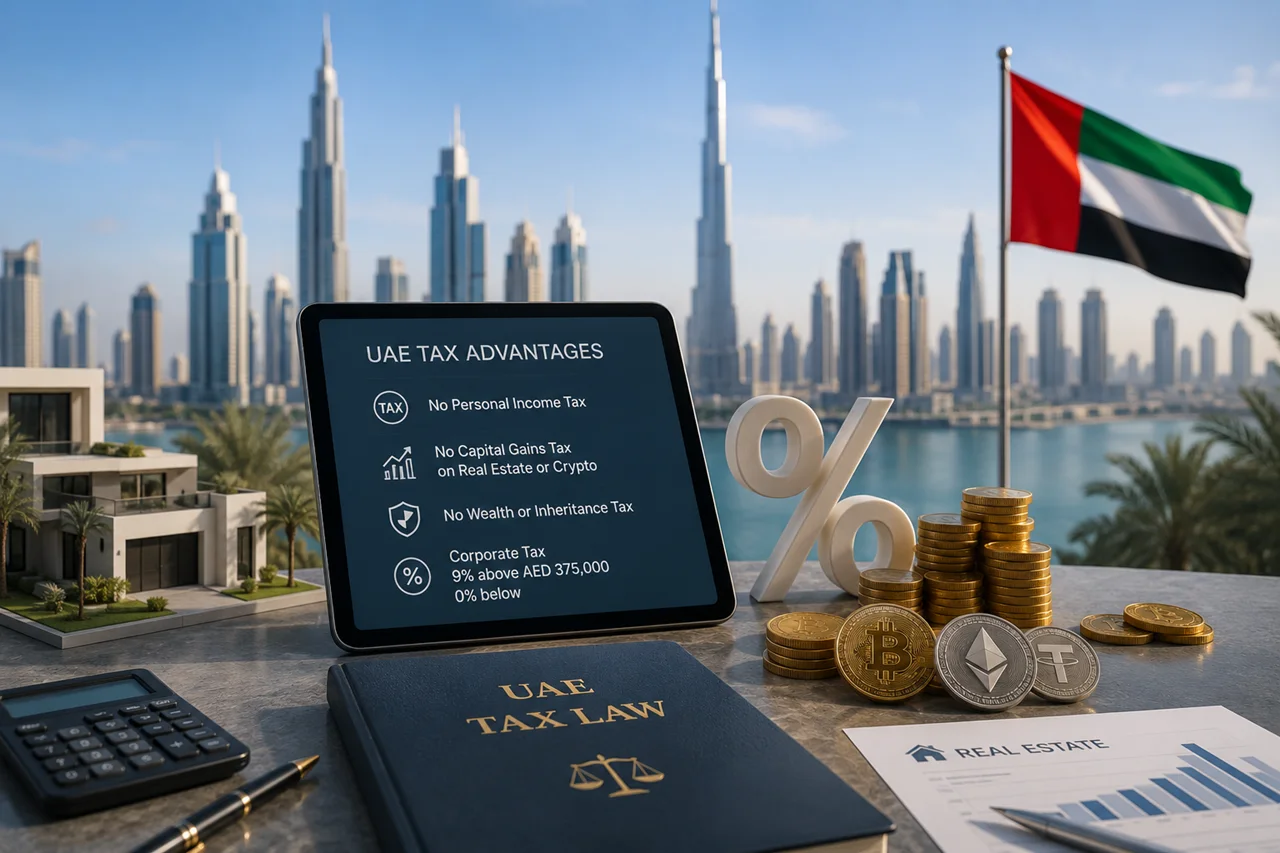
The UAE remains one of the most tax-friendly major property markets:
• No personal income tax.
• No personal capital gains tax on real estate or on personal crypto holdings.
• No wealth or inheritance tax at the federal level.
The UAE introduced Corporate Tax under Federal Decree-Law No. 47 of 2022, effective for financial years starting on or after 1 June 2023. Headline points:
• 9% rate on taxable profits above AED 375,000; 0% below.
• Individuals are inside Corporate Tax only if they conduct a "Business or Business Activity" with turnover above AED 1 million per year. Passive personal investment income (including a one-off personal crypto-to-property conversion) is typically outside scope.
• Qualifying Free Zone Persons can access 0% on qualifying income subject to substance and audit requirements.
• Real estate businesses (developers, flipping at scale, short-term rental operators above the threshold) can fall into Corporate Tax.VAT on crypto:
In late 2024 the UAE Cabinet amended the VAT Executive Regulation to exempt transfers and conversions of virtual assets from VAT, with retroactive effect to 1 January 2018. Businesses dealing with virtual assets were invited to file voluntary disclosures to correct historical filings. This is materially helpful: the on-chain transfer and the conversion to AED are not VATable events.
VAT on real estate is unchanged:
• Commercial property: 5% VAT on sale and lease.
• First sale of new residential property (within 3 years of completion): zero-rated.
• Subsequent residential sales and leases: exempt.
• Bare land: exempt.
Home-Country Side (General Principles, Not Advice)
Converting crypto into property is, in most jurisdictions, a disposal of the crypto and therefore a taxable event in your country of tax residence. Even though the UAE does not tax you on it, your home country may.
General patterns (always confirm with a cross-border tax adviser):
United Kingdom:
HMRC treats crypto as a chargeable asset. Disposing of it (including spending it on a Dubai apartment) triggers Capital Gains Tax. Under the HM Treasury Autumn Budget 2024, delivered by Chancellor Rachel Reeves on 30 October 2024, CGT rates on assets (including crypto) rose to 18% for basic-rate taxpayers and 24% for higher-rate taxpayers with immediate effect from that date. The annual exempt amount is £3,000 from 2024/25.
United States:
The IRS treats crypto as property (Notice 2014-21). Disposing of crypto realises short-term gain (ordinary rates up to 37%) or long-term gain (0/15/20% plus 3.8% NIIT). US citizens and green-card holders remain taxable on worldwide income even while UAE-resident, and must report foreign assets (FBAR, Form 8938) and any specified crypto activity.
Germany:
Crypto held by a private individual for more than 12 months is generally tax-free on disposal under §23 EStG. Held for less, gains are taxed at marginal income-tax rates (up to 45% plus solidarity surcharge) with a €1,000 annual exemption from 2024.
France:
Occasional crypto disposals by individuals are taxed at the flat 30% PFU (12.8% income + 17.2% social charges).
India:
Section 115BBH imposes a flat 30% tax on virtual digital asset gains, plus surcharge and cess; 1% TDS under Section 194S on transfers above the de minimis threshold; no loss set-off.
Pakistan, Iran, Russia, Turkey:
Treatment ranges from outright prohibition of crypto use to ambiguity. Buyers from these jurisdictions should pay particular attention to source-of-funds documentation (it determines future repatriation feasibility) and to any foreign-asset declaration obligations they may have at home.
The Practical Rule
Document everything: original acquisition cost of the crypto, dates, exchange statements, the SPA, the VASP conversion confirmation, the DLD title deed. You will need this set of documents to:
1. File correctly in your home country.
2. Resell the Dubai property cleanly in future.
3. Refinance or remit proceeds out of the UAE.
This is the single biggest reason to consult a cross-border tax adviser before you sign the SPA, not after. If you would like an introduction to advisers who handle UAE–UK, UAE–US, UAE–EU, UAE–India, and UAE–CIS structuring, contact us.
Benefits of Buying with Crypto
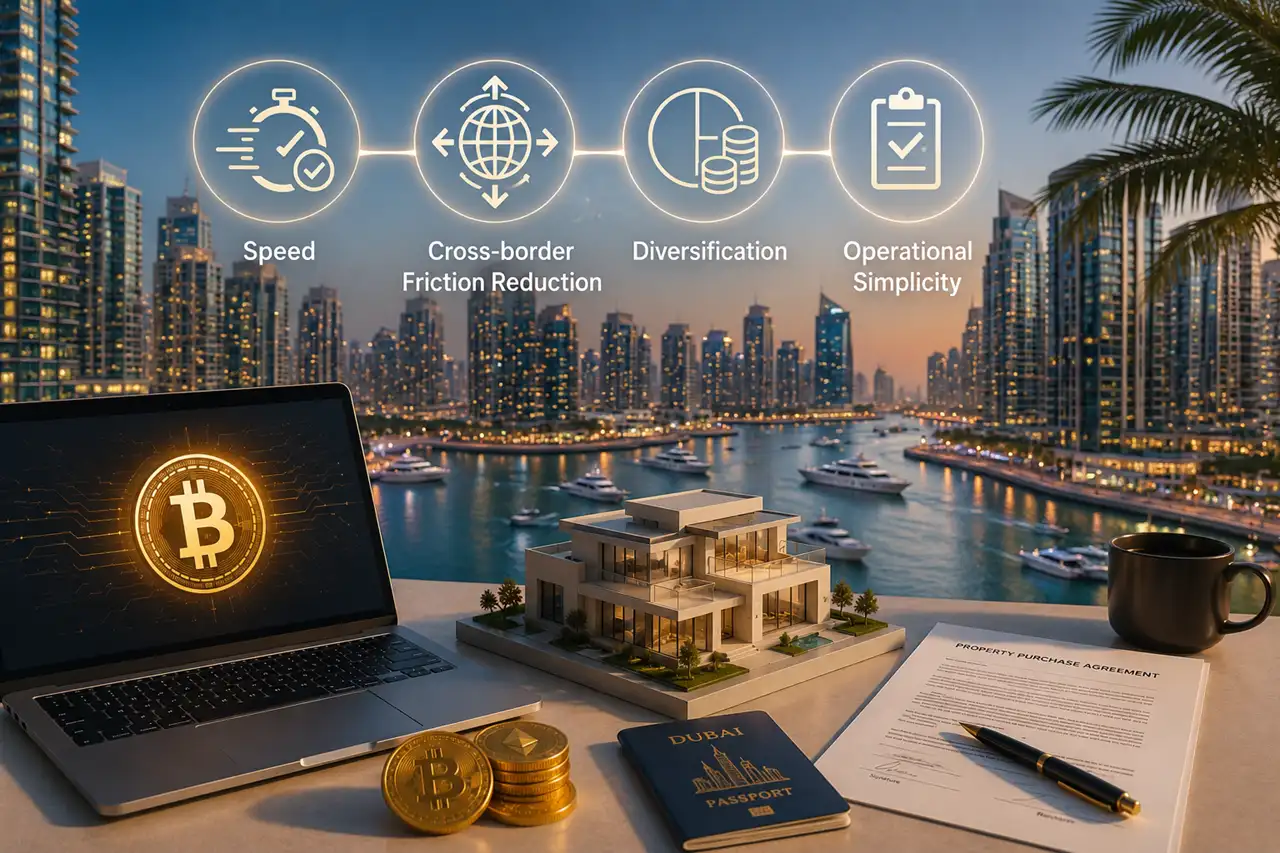
Speed:
Stablecoin rails settle in minutes; bank wires from many jurisdictions take days.
Cross-border friction reduction:
Especially useful from countries with capital controls or weak correspondent banking.
Diversification:
Rotating part of a concentrated crypto portfolio into Dubai real estate (a hard, yielding asset in a stable jurisdiction) is a popular thesis.
Operational simplicity:
One OTC ticket replaces multiple SWIFT hops.
Off-Plan vs. Ready / Secondary
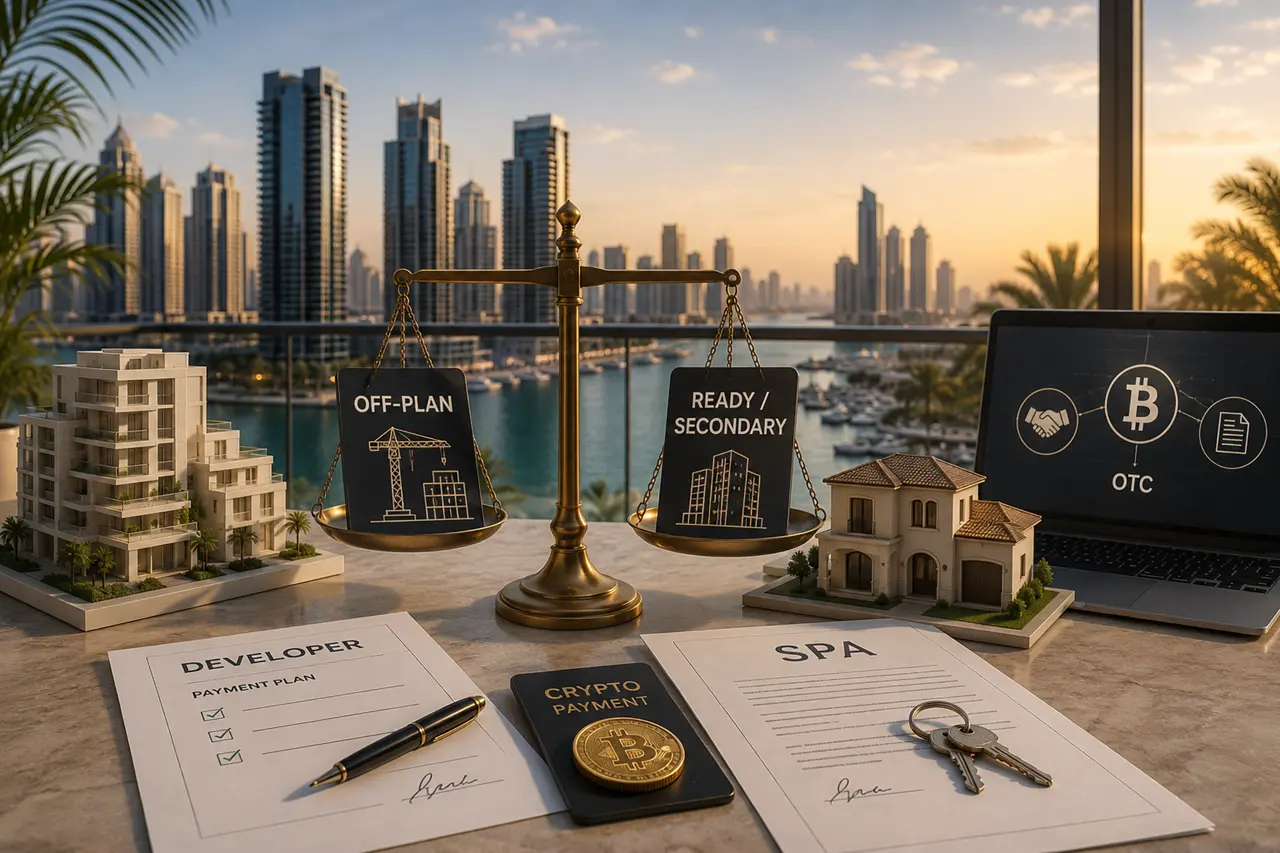
Off-plan from a developer:
Cleaner crypto SOPs (the developer has done it before), staged payments, Oqood registration, longer time to title deed. Good for crypto-native buyers who want the institutional comfort of a regulated counterparty.
Ready / secondary from an individual seller:
Harder to find a willing crypto-accepting seller; usually intermediated by a brokerage that runs the conversion via OTC and pays AED to the seller. Faster transfer of title once the SPA is signed.
Frequently Asked Questions About Buying Property in Dubai with Cryptocurrency
Is it legal to buy Dubai property with crypto?
Yes. Crypto is not legal tender in the UAE, but virtual assets are regulated under VARA, and crypto can be lawfully converted to AED through a licensed VASP and used to settle a DLD-registered property purchase. The title deed itself is denominated in AED.
Which cryptocurrencies are typically accepted?
USDT, USDC, BTC, and ETH are standard. Stablecoins (USDT, USDC) are preferred for settlement because they eliminate price volatility during closing. Some desks will quote BNB, XRP, SOL, or LTC on request.
Do I pay capital gains tax on the crypto I use?
Not in the UAE if you hold the crypto personally (no personal capital gains tax). However, your home country very likely treats the conversion as a taxable disposal. UK, US, French, and Indian residents in particular should expect a tax bill on the gain between original crypto cost and the AED value at conversion. Get cross-border tax advice before you sign.
Can I get a mortgage if I pay the down payment in crypto?
Sometimes. UAE banks lend in AED, not crypto, but several lenders will accept a crypto-funded down payment provided the source of funds is documented to AML standards. Expect more scrutiny than a salary-funded down payment, and budget extra time for the credit committee.
Can a non-resident buy Dubai property with crypto?
Yes. Non-residents can buy in designated freehold areas (most of new Dubai) on the same terms as residents. KYC is more thorough for non-residents, especially for source-of-funds and source-of-wealth, but the structure is identical.
How long does the process take?
A ready-property crypto-settled deal typically closes in two to four weeks end to end, similar to a traditional cash deal. The crypto leg itself is minutes to hours; the rest is KYC, SPA, NOC, and DLD scheduling. Off-plan deposits can move in days.
Final Word and Next Step
Buying property in Dubai with cryptocurrency is, in 2026, a mature and well-regulated process, not a frontier experiment. The legal framework (VARA plus DLD plus CBUAE) is in place, the on-ramps and off-ramps work, and the tax treatment on the UAE side is favourable. The two places where most deals go wrong are (1) the SPA being drafted without proper crypto clauses, and (2) the buyer overlooking the home-country tax consequences of the conversion.
If you are ready to deploy crypto into Dubai real estate, contact us for the current list of developers and projects accepting cryptocurrency, an introduction to a VARA-licensed OTC desk that can handle your deal size, and a conveyancer who has closed crypto-settled transactions before. We will help you structure the deal so that the AED price, the crypto leg, the KYC pack, and the DLD registration line up cleanly the first time.
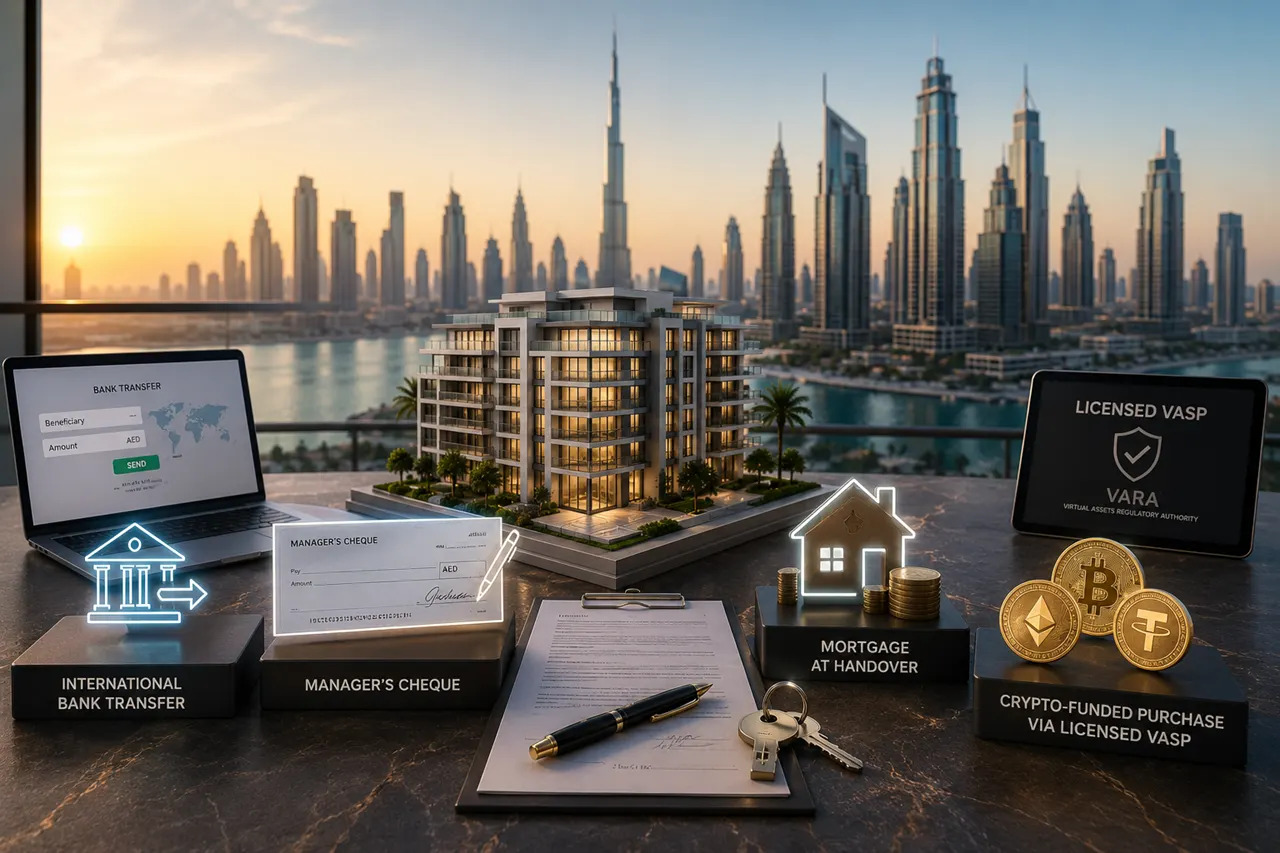
Master All Dubai Property Payment Methods
Compare escrow bank wires, developer payment plans, and fees to maximize your off-plan investment returns.
The Manager’s Cheque Compliance Guide
Avoid transaction delays by mastering UAE Central Bank rules, required names, and DLD fee schedules.
For any questions about your real estate investment, message or call me directly. I’m here to guide you toward the best opportunities in Dubai.

This website uses cookies to ensure you get the best experience on our website.
Let’s build your Dubai portfolio together
+971 543 443 597
- Privacy Policy
- Terms & Conditions
- Customer Policy.
Copyrights © 2025 Tohid Fetrat
×