Returns · Buying Process Guide
Dubai Real Estate ROI Guide
Rental Yields, Gross vs Net Return, and How to Calculate What You Actually Keep
ROI in Dubai usually means rental yield, and the advertised figure is gross. This guide shows what counts as a good yield, how to calculate net return after ownership costs, and what reduces it.
Direct advisor access. Every buying question answered personally, never by a call center.
ROI in Dubai
What ROI Means in Dubai Real Estate
Return is the question behind every step of buying property in Dubai, and in Dubai the word usually means one thing: rental return. When an agent quotes ROI, they almost always mean annual rent as a share of the price, not growth in the property's value.
Market averages reported for April 2026 put the gross yield at about 6.57% for residential property, 7.08% for apartments, and 4.54% for villas. Prime and luxury homes often yield less, simply because their prices are higher.

Rental Income
Annual rent from the property, the figure most ROI quotes refer to.
Capital Appreciation
Growth in the property's value over the holding period, modelled separately because it is never guaranteed.
What Is a Good ROI in Dubai
Below 5%
Common in some prime or luxury properties.
5% to 6%
A moderate rental return.
6% to 8%
A strong range for many Dubai properties.
8% to 10%
High yield, often found in selected affordable areas.
Above 10%
Possible in limited cases, but requires careful verification.
A higher yield does not automatically make a better investment. These are gross market averages, not guaranteed returns, and the yield that matters is the one left after costs.
Where Yields Are Highest
Dubai Areas With High Rental Yields
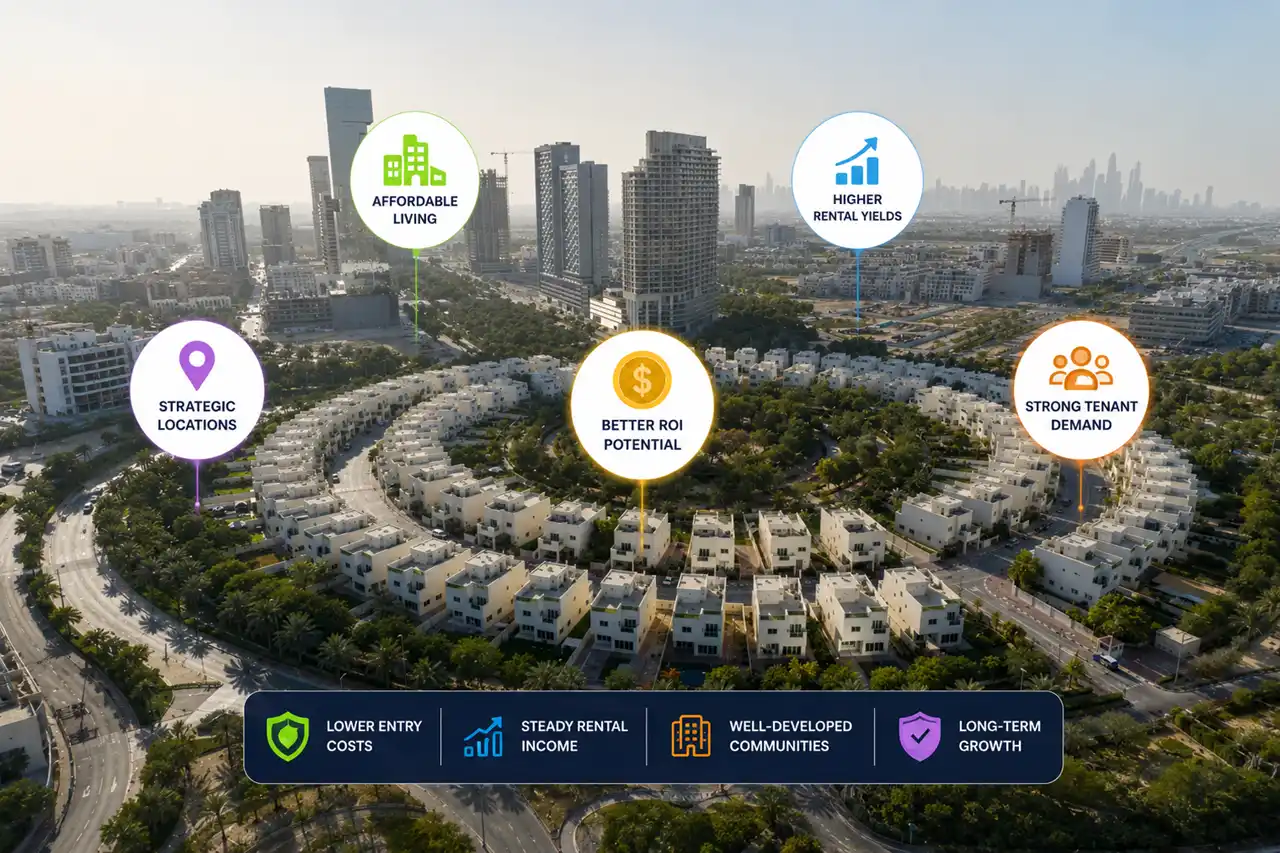
The highest yields usually come from affordable, mid-market communities, where lower prices meet deep tenant demand. Commonly cited names include International City, Dubai Investment Park, Discovery Gardens, Jumeirah Village Circle, Arjan, Town Square, Al Furjan, Dubai Silicon Oasis, Dubai Sports City, and DAMAC Hills 2.
Average Rental Yields in Dubai by Community
Reported gross apartment yields by community, read as market indicators rather than a promise for any single unit:
International City
9.10% to 10.30%
Dubai Investment Park
9.44% to 9.90%
Discovery Gardens
7.77% to 9.47%
Living Legends
Around 8.76%
Al Sufouh
Around 8.73%
Town Square
Around 8.00%
Arjan
Around 7.90%
Al Furjan
Around 7.72%
Jumeirah Village Circle
Around 7.59%
A community average is not your unit's return. Price, service charges, condition, floor, view, layout, and future supply move the yield as much as the area does, so browse Dubai areas and communities before you compare individual units.
The Calculation
Gross ROI vs Net ROI and How to Calculate It
Most advertised returns are gross, which leaves out most of what ownership costs. Net yield is the honest number, and it is the one I calculate for every client before a reservation.
Gross Yield
Annual rent divided by the purchase price.
Net Yield
Annual rent minus annual expenses, divided by the total acquisition cost.
How to Calculate Property ROI in Dubai
Total Acquisition Cost
Add the purchase fees to the price to find what the property really cost you.
Achievable Rent
Estimate the rent from real comparable evidence, not from asking rents in the building.
Annual Expenses
Deduct service charges, management, maintenance, vacancy, and insurance.
Yield and Cash Flow
Calculate gross and net yield, then cash flow and cash-on-cash return if the purchase is financed.
Dubai Real Estate ROI Calculator
It opens on the worked example: a property priced at AED 1,500,000 ≈ USD 408,441, renting for AED 110,000 ≈ USD 29,952 a year. Replace any figure with your own and the results update as you type.
Purchase fees follow the worked example. Mortgage costs are not included.
Net rental yield
5.26%
Gross rental yield 7.33%
Where your gross yield sits
- Under 5%
- 5 to 6%
- 6 to 8%
- 8 to 10%
- Over 10%
Estimates for comparing properties, not a guaranteed return.
The calculator assumes a cash purchase, as the worked example does. A mortgage adds registration, arrangement, and valuation costs of its own, and the right measure then becomes cash flow and cash-on-cash return.
Want this calculation run on a unit you are considering? Ask me to run the numbers on WhatsApp
What Reduces Your Return
Costs That Reduce Your Property ROI
Costs arrive at three moments: when you buy, every year you own, and when you sell. Each one belongs in the calculation from the first conversation, not the last.
Purchase Costs
DLD registration fee, trustee registration fee, brokerage commission, title deed and map charges, mortgage registration, bank arrangement fee, property valuation, and conveyancing fees.
Annual Ownership Costs
Building service charges, community charges, maintenance, insurance, property management, vacancy, leasing commission, utility expenses paid by the owner, and furniture replacement.
Selling Costs
Brokerage commission, mortgage settlement, developer NOC fee, conveyancing, maintenance before resale, and property preparation and marketing.
Service Charges
Service Charges and Their Impact on ROI
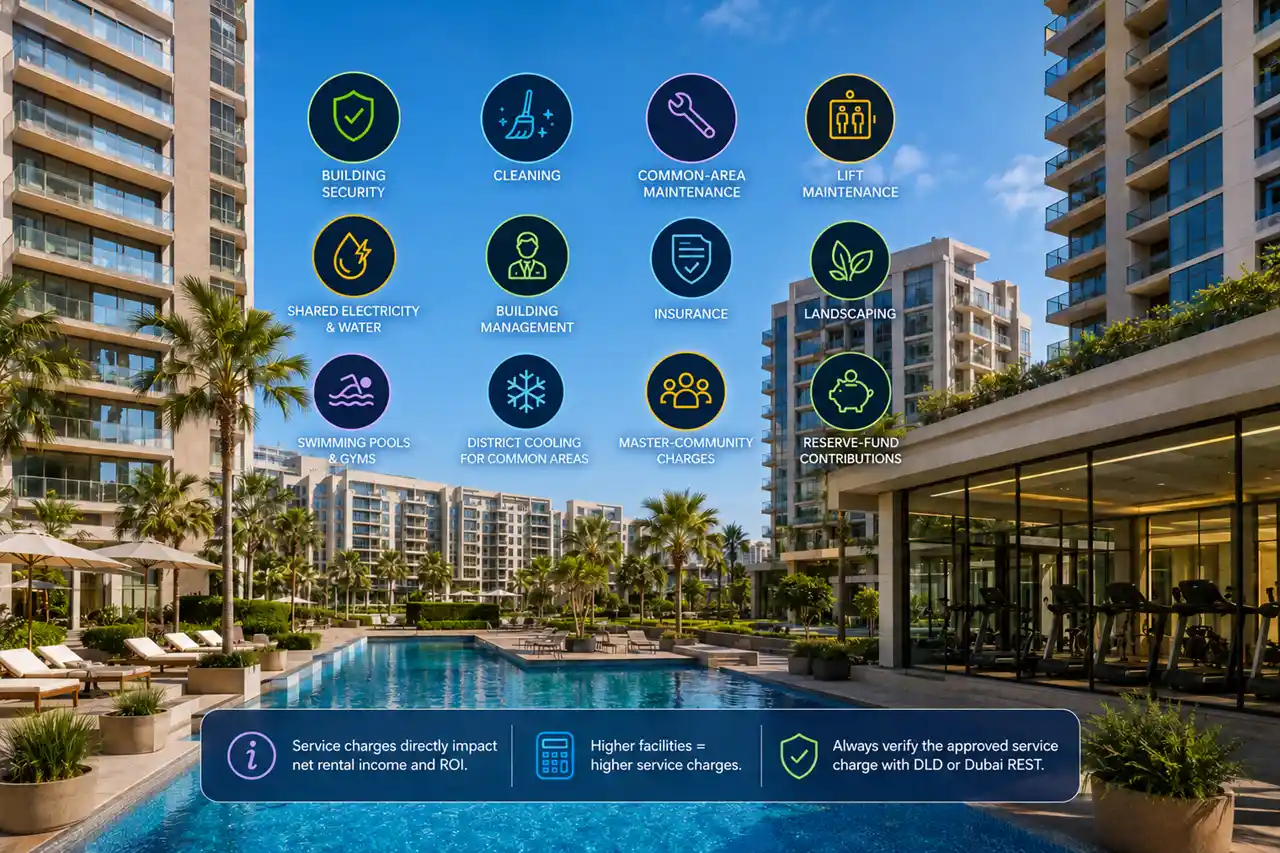
Service charges are the expense that most often separates gross from net. A building with generous amenities can carry charges high enough to cut the net yield sharply, so I check them before I look at the rent.
Verify the approved figure through official DLD or Dubai REST sources rather than a sales brochure. On an off-plan unit, service charges start at the stage covered in my guide to Dubai property handover.
Apartments and Villas
Apartment ROI vs Villa ROI
Apartments usually win on yield and villas on stability. Which one fits depends on whether your return is meant to come mainly from rent or from long-term value.
Apartments: About 7.08% Gross
Lower purchase prices, a broad tenant market for studios and one-bedroom units, higher rent per square foot on smaller units, more price categories, and more accessible entry costs.
Villas: About 4.54% Gross
Longer tenant retention, family demand, limited supply in established communities, stronger capital appreciation, larger land components, and lower tenant turnover.
Ready Property vs Off-Plan ROI
Ready Property
The return can be checked against evidence: existing rental contracts, current market rent, actual service charges, building condition, tenant demand, maintenance history, vacancy levels, and comparable sales.
Off-Plan Property
The return is a projection, built from price appreciation during construction, rental income after handover, a below-market launch price, flexible payment plans, and resale. Calculate the yield on the full purchase price, not the installments paid so far.
An off-plan projection carries its own risks: construction delays, changes in market rent, future supply, handover quality, service charges, mortgage availability, resale restrictions, and changes to the surrounding area.
Long-Term vs Short-Term Rental ROI
Long-Term Rental
More stable annual income, lower management costs, fewer cleaning expenses, reduced utility costs, lower furniture replacement, less seasonal vacancy, and fewer daily operational responsibilities.
Short-Term Rental
A higher gross with more to deduct: holiday-home management commission, cleaning, electricity and water, internet, platform charges, linen and consumables, furniture replacement, seasonal vacancy, permit fees, and tourism-related charges. Compare net annual income, not nightly rates.
On tax, there is no personal income tax for individuals in the UAE, and qualifying rental income may fall outside Corporate Tax. Companies, licensed activities, and foreign tax residents may face different rules, so take professional tax advice for your ownership structure.
Before You Commit
Risks and How to Compare Dubai Investment Properties
Every projected return carries risk, and the only fair way to compare two properties is to run both through identical assumptions.
Risks That Can Affect Property ROI
Vacancy risk
Rental price changes
Service charge increases
Maintenance risk
Construction delays
Oversupply
Financing risk
Resale risk
Overpayment risk
How to Compare Dubai Investment Properties
Total purchase and acquisition cost
Realistic annual rent
Gross rental yield
Annual service charges
Maintenance allowance
Vacancy allowance
Property management cost
Net rental yield
Expected future supply
Tenant demand
Building and developer reputation
Resale liquidity
Potential capital appreciation
Investment risks
The factors behind a sound shortlist are set out in my guide to choosing the right property in Dubai, and the 4% DLD fee in the acquisition cost is typically paid at the stage explained in Oqood registration in Dubai. Payments, protection, and the Golden Visa are covered across my Dubai real estate guide library.
FAQs
Dubai Real Estate ROI Frequently Asked Questions
A gross rental yield of about 6% to 8% is generally considered good in Dubai. Affordable communities can yield more, while luxury properties often yield less.
When agents quote ROI in Dubai, they usually mean rental income. Price appreciation should be modelled separately, because it is not guaranteed.
Apartments generally produce higher percentage yields. Villas can offer family demand, longer tenancies, and stronger capital appreciation.
Some affordable properties may approach a 10% gross yield, but the figure must be verified against the real price, achievable rent, and ownership costs.
Advertised ROI is usually gross, which excludes most ownership costs.
Service charges reduce net income, so high charges can make the net yield much lower than the gross yield.
Use the full purchase price and the projected rent after handover, and treat the result as a projection rather than a confirmed return.
There is no personal income tax for individuals in the UAE, and qualifying rental income may fall outside Corporate Tax. Companies, licensed activities, and foreign tax residents may face different rules.

Your Advisor
Tohid Fetrat
For any questions about your real estate investment, message or call me directly. You will always reach me personally, never a call center or sales team.